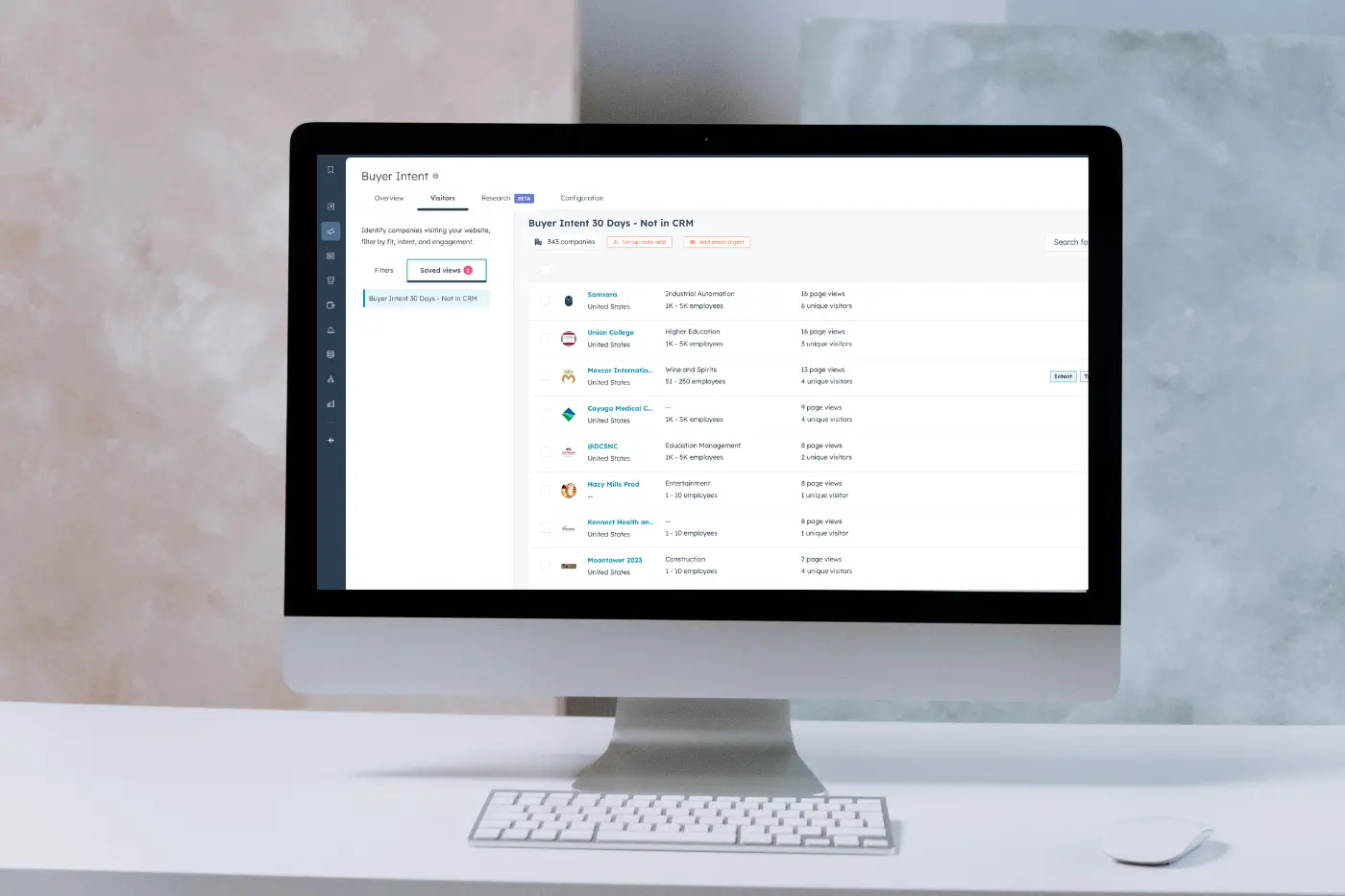

Developing a B2B strategy involves a step-by-step approach: define your market, build educational content that establishes trust and provides compelling reasons to act, execute signal-based outreach to catch buyers with active budgets, and optimize your CRM and analytics to track the KPIs that lead to real revenue. Here’s the quick answer:
Identify Your Target Audience: Before launching campaigns, map out exactly who you are selling to and how their buying committees operate.
- Your Ideal Customer Profile: Define company size, industry, revenue, and geography.
- Your Buying Committee Personas:
- Identify the stakeholders (e.g., CFO, IT Director), their unique pain points, and how they make decisions.
Craft Your Value Proposition & Your Messaging Matrix
- Clearly outline what makes your business unique and how you help clients solve problems.
- Focus on ROI, efficiency, and real-world outcomes.
- Develop a niche to become an indisputable expert in your specific space.
Create Content and Give it a Home
B2B buyers prefer clarity and education over high-pressure sales. Make sure your website is educational and sales-ready at the same time, and don’t discount the high value of content marketing in the age of AI search.
- Revise or launch a B2B sales-ready website
- Create and promote thought leadership content, like guides, articles, use cases, and short explainers on your website and platforms like LinkedIn.
- Nurture leads using in-depth resources, webinars, and targeted email campaigns.
Stop Cold Calling and Switch to Signal-Based Outreach
Instead of cold-calling at random, focus on timing and buyer intent.
- Target accounts showing research intent, website activity, or recent funding events.
- Get to the point: Remember that you have about 3 seconds to grab attention and 3 messages to earn a real reply.
Establish a Tech Stack and Review Cycle
Ensure your strategy is sustainable by automating repetitive tasks and tracking results.
- Utilize a robust CRM system to manage relationships and pipeline.
- Set up reporting to track key performance indicators such as Qualified Demos, MQLs (Marketing Qualified Leads), and Customer Acquisition Cost.
“It’s like having a B2B marketing strategy template.”
Peer Sales Agency provides a proven framework for B2B sales and marketing that eliminates the guesswork. We’ve been testing AI tools, outreach methods, campaigns, and content for the last two years: we know what works and we can save you time and the cost of experimentation.
With our revenue generation strategies, we help B2B businesses transition from founder-led sales or chaotic cold outreach to a structured, repeatable revenue engine that consistently attracts and closes deals.
Start a conversation with CEO, Sara Hanlon, and get on the road to revenue.
Should I keep my B2B marketing strategy in-house or get outsourced help?
This isn’t an either-or situation. In reality, marketing strategies work best when your in-house team is collaborating with reliable experts in the tactics and business leadership you need to use to find new customers. The best outsourced partners collaborate with you as an extension of your team.
“There’s always going to be certain components with any revenue operations system that nobody wants to own in-house. So, it becomes a question of what you want to own. What do you want to have the capability and capacity to manage yourselves? Once you decide that, you can find AI or trusted outsourced partners to augment and accelerate your operations.”
Sara Hanlon, CEO
Getting started: Identify Your Target Audience: ICP and Personas
Your ICP: Ideal Customer Profile
Your B2B marketing strategy begins with firmographics. Focus on specific criteria like company size, industry, revenue, and geography. By identifying the exact “shape” of your best customer companies, you ensure your sales and marketing efforts are never wasted on accounts that aren’t a strategic fit.
Your Buying Personas
B2B is a team sport, and you need to know the whole roster. Research the buying committee – the people – within your target companies to understand the unique pain points of decision makers and stakeholders, such as the CFO, IT Director, or department heads. Speaking to their specific motivations, and solving their unique pain points, is the only way to move B2B buyers from stranger to evangelist.
Defining what makes your business, products, or services unique with a messaging matrix
Clearly articulate the unique value proposition of your business. What makes you different? What makes you better? What makes you unique?
Focus on real-world outcomes for the end customer: ROI, operational efficiency, and tangible improvements. Develop a niche to become an indisputable expert.
When you have everything decided, write a messaging matrix to ensure that every social media post, email, and sales conversation remains consistent and on-brand.
What are the essential steps for a successful B2B marketing strategy?
Step one: Revise or build your B2B website
Your website is your primary conversion tool. Build it specifically for your identified ICP and personas, ensuring your value proposition is front and center. Make sure you’re following the principles of B2B sales-ready websites from the get-go; otherwise, you stand to waste a lot of time and money on developing a website that won’t move the needle.
Step two: Build educational B2B content
Buyers prioritize clarity, and most want to feel like their partnerships and purchases were their idea from the beginning. Modern buyers don’t want to be sold at; they want to make up their own minds, then choose a provider.
To get yours on the shortlist, use content marketing to provide value. At the top of the funnel, prioritize educational or thought leadership content, like guides, articles, use cases, and short explainers on your website and platforms like LinkedIn. In the middle, nurture leads through the buyer’s journey using in-depth resources, webinars, and targeted email campaigns.
In the age of AI search, the only way to get cited and mentioned by answer engines like ChatGPT, Gemini, Perplexity, or Claude is to provide content that’s written to answer human questions about real problems.
Step three: Help your B2B sales team with great enablement
Create assets that help your team sell effectively. Essential sales enablement assets include:
- Nurturing articles and FAQs.
- Case studies and success stories.
- One-pagers on specific product capabilities or service lines.
- Competitor comparison battlecards.
- ROI calculators.
- Email templates and sales sequences.
Step four: Design and launch a campaign
Tie your website, content, and sales assets together into unified, integrated marketing campaigns. This generates awareness and captures high-intent traffic, bridging the gap between passive interest and active sales engagement.
Remember: sales and marketing should use the same CRM
Alignment fails when teams live in different worlds. Using a shared CRM allows for transparent communication and prevents leads from falling through the cracks.
Step five: Implement signal-based outreach with your sales team
Focus on timing. Use intent data like website activity or funding events to identify active buyers in your ICP. Remember the rule of 3s: your outreach has about 3 seconds to grab attention and a sales sequence gets 3 messages to earn a response. Add immediate value, prioritize relevance, and remember: be the helpful consultant, not the pushy sales person.
Step six: Establish your shared KPIs and review cycle
Sales and marketing should share and track metrics like MQLs, Qualified Demos, and Customer Acquisition Cost (CAC) to measure performance. Make sure there’s a shared meeting cadence between sales and marketing so that everyone is in the loop.
Get the B2B Marketing Strategy Help You Need to Succeed
A robust B2B strategy is an iterative loop. By defining your target audience, producing high-value educational content, and enforcing strict sales-marketing alignment via shared data, you build a sustainable growth engine.
Peer Sales Agency specializes in helping mid-size businesses build scalable, revenue-driven strategies that shorten sales cycles and maximize growth.
We’re here to help. Start the conversation today.
FAQ: B2B Marketing Strategy
A strategy aligns your resources with your goals, ensuring consistent, predictable revenue. A comprehensive strategy allows you to focus on the right audience. With a clear strategy, you can allocate budgets and resources effectively, ensuring that your marketing efforts are both cost-efficient and impactful. This prevents wasted time and money.
Define your ICP, build a messaging matrix, create educational content, use intent signals and consultative sales to make connections with interested buyers, and align sales and marketing teams through a shared CRM.
Content educates buyers and feeds AI search tools, ensuring your brand appears when prospects conduct research, whether they prefer traditional search or generative engine/answer engine tools.