
You were a small business. You put your nose to the grindstone, and it worked: your founder-led sales approach, your funnel full of (mostly) referral business, and your scrappy “see what works” approach helped you build something bigger.
Now, you’re in the mid-market, with more competition, and you hit a ceiling. It’s not because your product lacks market fit. It’s because it’s time to scale your revenue engine.
As companies scale from founder-led revenue generation to building out dedicated sales teams, they frequently encounter the “growth paradox.” This is the point where the founder’s intuition — the secret sauce that closed every early deal — no longer scales. Without moving the founder’s process out of their heads and into a robust sales enablement strategy, the sales pipeline inevitably stalls, lead conversion drops, and the new team struggles to replicate the success that once felt effortless.
The Mid-Market Growth Paradox: Why Your Sales Engine is Stalling
The transition from founder-led sales to creating a structured sales team often feels like the most dangerous inflection point for any growing business.
When a founder is the primary rainmaker, the “sales process” exists entirely within their head. This works for early-stage growth, and you can keep it that way for a long time… but it creates a massive bottleneck when you hire sales reps who lack that institutional context. Without standardized sales enablement assets, these new hires are essentially flying blind. They lack the nuanced messaging, the collateral, and the frameworks required to actually find and convert leads.
When your B2B business hits this wall, your pipeline stalls because your sales reps spend too much time improvising and guessing, leading to inconsistent performance and long, unpredictable sales cycles.
From Founder-Led Sales to a Repeatable Process
To scale, you must codify the “founder magic” into a repeatable system. This requires capturing the tacit knowledge — the specific objection handling, the narrative arcs, and the strategic positioning — and turning it into formal sales enablement assets.
When this knowledge is trapped in a founder’s mind, the company’s revenue growth is literally capped by the founder’s time. As a company’s revenue grows, the founder’s time dwindles: responsibilities of actually running the business pile up and eat into sales time.
By documenting the sales processes that got you to this point, founders can provide a new bench of sales reps with the tools they need to succeed. If you want to continue to be successful, you have to bite the bullet and invest in a scalable sales architecture where every rep can perform at a high level.
Defining the “Enablement Maturity Model” for Mid-Market B2B Businesses
Mid-market companies, especially B2B businesses, need a structured roadmap to move toward revenue engine maturity.
Essential collateral includes messaging matrices, clear value propositions, playbooks, case studies, sales decks, supportive sales enablement and buyer education articles, and standardized email and outreach sequences that ensure brand consistency.
Investing in a CRM (we like HubSpot) is non-negotiable at this stage; these tools provide the framework to track prospect interactions through every stage of the sales cycle, from initial outreach to closed-won. The intelligence captured there helps you understand which pieces of your sales process are working, and which aren’t, so that you can double down on the right tactics. This shortens your sales cycle and removes friction from the buyer’s journey.
Don’t forget high-quality marketing content: case studies, whitepapers, websites, ROI calculators, downloadable resources, social media content and campaigns.
Everything your marketing arm creates must be aligned with your specific buyer’s journey stages to help prospects “choose their own adventure,” before coming to the sales team, effectively turning passive interest into an active pipeline.
The Foundation: Three Things to Start Your B2B Sales Enablement Toolkit
Building a high-performance sales organization requires moving away from gut-feeling outreach and “just checking in” emails. At this stage of the game, you’re moving toward a strategy that’s fully informed by a well-researched buyer profile, their behavior and needs, and data-driven insights from your portfolio and elsewhere.
Refined ICPs and Buyer Personas: Who Do You Think You’re Talking To?
Your Ideal Customer Profile (ICP) defines the specific company characteristics you serve best, while buyer personas identify the individual stakeholders within those companies. Without these, your sales teams are wasting time on companies that don’t need you and leads that will never convert.
Your enablement strategy should be centered around these profiles, ensuring that every piece of messaging resonates with the specific pain points and goals of your target audience.
Take a deep dive into isolating the right ICP.
Then, learn everything you need to know about creating B2B buyer personas in this article.
A Buyer’s Journey Map for the Multi-Stakeholder Journey in Mid-Market B2B Sales
Mid-market B2B sales are rarely one-to-one; these buying decisions involve a committee of stakeholders. Before creating new assets, audit your existing sales enablement and marketing content to see how it aligns with the buyer’s journey. Your marketing team likely has a repository of blog posts, presentations, and collateral that, when mapped correctly, can serve as powerful sales enablement tools. By aligning existing assets to the specific stages of the journey, you can reduce the time reps spend searching for the right message — and reduce the number of net new assets you need to create as part of your efforts to scale.
Smart Outreach Strategies: Using Buyer Intent Signals to Prioritize Outreach
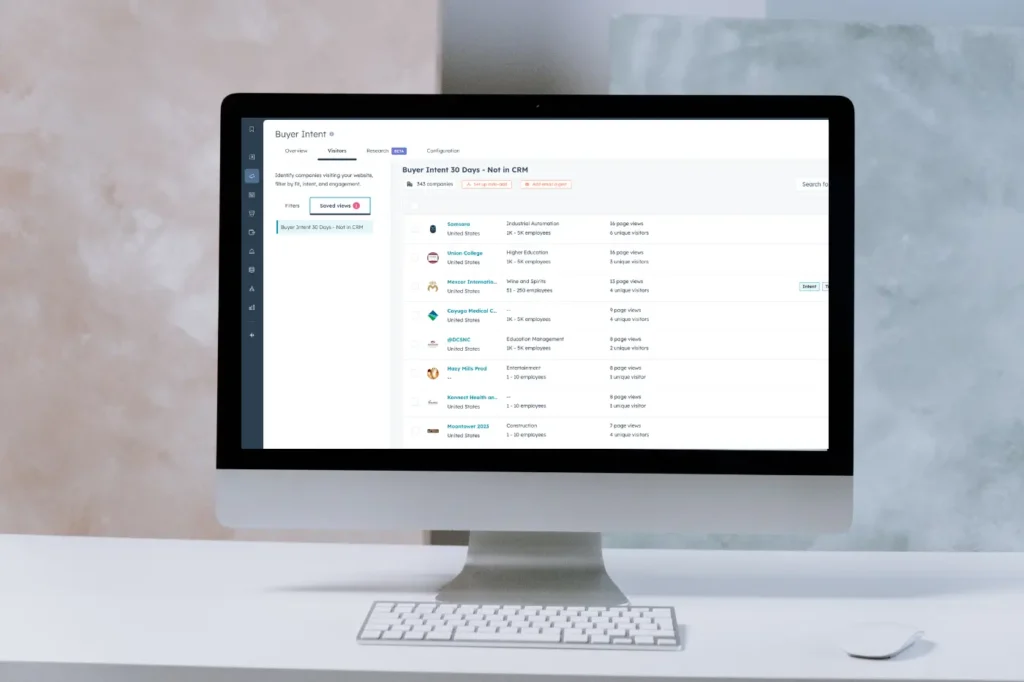
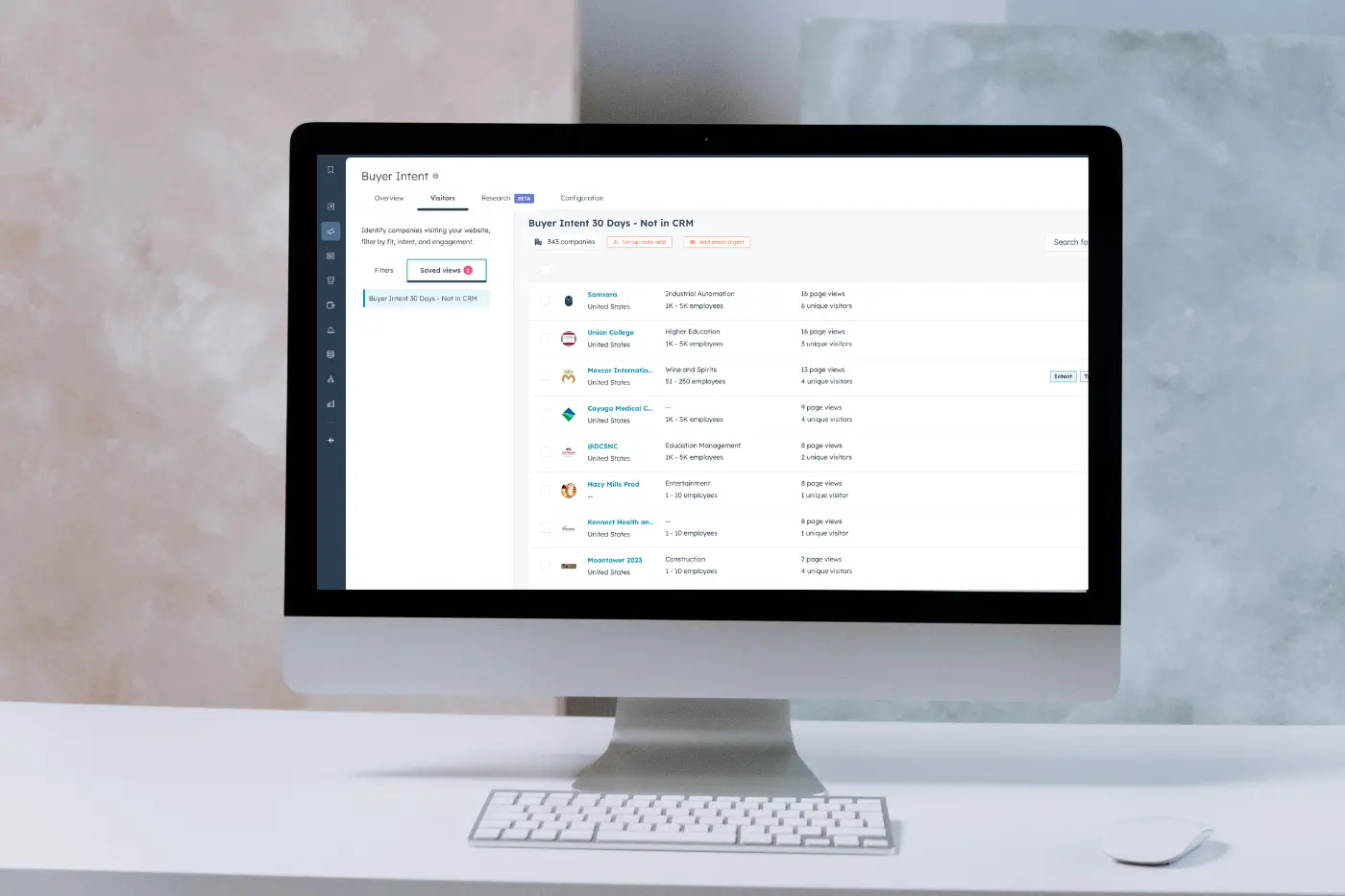
Modern sales enablement tools allow you to move from spray-and-pray prospecting to more targeted outreach. By leveraging intent data in software like HubSpot’s Buyer Intent or using Apollo’s Intent filters, you can identify prospects who are actively researching solutions that mirror (or even compete with) yours.
These tools allow your sales reps to prioritize actions and outreach based on real-time data, ensuring that they focus their energy on prospects most likely to engage in a conversation.
Solving the “Content Chaos” Problem
Marketing makes assets. The founder definitely has a lot of their own decks, templates, sales slicks, and outreach. Your new sales team has been cobbling together their own versions of whatever they can find in PowerPoint. Welcome to content chaos.
This common problem is a huge time-suck, forcing sales reps to spend hours searching for (or recreating) the “latest version” of a proposal, email, or case study. Untangling the mess requires a systematic approach to auditing, centralizing, standardizing, and measuring the performance of your assets.
Auditing Your Content Library: Slide Decks, Case Studies, and Articles
Use Peer Sales Agency’s Buyer’s Journey Map template to audit your library. Categorize what you have, identify what’s missing or outdated, and determine the critical gaps you need to fill for your sales team first.
This audit clarifies exactly what needs to be created to support your sales reps. By focusing on high-impact assets that address specific stages of the sales process, you ensure that every investment in added assets for your B2B sales enablement library serves a clear purpose.
Centralizing Assets for Instant Access
Your sales enablement platform, whether integrated within HubSpot or somewhere else, must act as the single source of truth for all your sales team’s collateral needs.
When every case study, proposal template, outreach sequence, and sales deck lives in one centralized repository, you eliminate the friction of searching. This centralized access empowers reps to personalize their outreach quickly, maintaining momentum throughout the entire sales cycle.
Using Content Analytics to Measure Buyer Engagement and Deal Velocity
With all your assets in a modern sales enablement CRM, you’ll have access to usage data.
Monitor metrics like content view rates, time spent on pages, and how specific assets correlate with deal velocity. If a particular slide deck consistently leads to faster movement through the pipeline, that’s a signal to double down on the messaging or promises in that asset.
Data-driven feedback allows you to refine your enablement strategy constantly, keeping you lean and efficient.
Optimizing the CRM: Ensuring Data Integrity and Pipeline Management
A CRM is only as valuable as the data inside it. Make sure your CRM has the basics: clean contact data, complete company information, and a pipeline with deal stages clearly defined, with specific triggers and exit criteria for each.
When your data is clean, you can forecast accurately and hold your sales teams accountable. Clear pipeline management ensures that no prospect falls through the cracks and that every opportunity is tracked through a standardized, measurable process.
Your CRM can only operationalize what it knows. It only knows what you give it. Your sales team’s participation and adoption of the CRM is critical, and leadership needs to enforce it.
Integrating Sales Automation and AI Agents to Reduce Administrative Burden
There’s a benefit to the sales team for all that data cleanliness: automation and AI agents can take great data and use it to eliminate hours of “book work” for the sales team.
The goal of automation is to remove repetitive, low-value administrative tasks so your sales reps can focus on high-touch connections with real people. Your team can use AI agents to handle lead qualification, appointment scheduling, and even basic follow-up emails.
By automating these actions, you free up your team to provide the strategic consultation that actually closes deals.
The Revenue Loop: Sales, Marketing, and Customer Success Alignment
Ongoing revenue growth is the result of a cohesive loop involving marketing, sales, and customer success working together to define success, establish clear goals and ownership, and find more opportunities to do great things for your customer.
Establishing Shared Goals and Unified KPIs Across the Revenue Cycle
When sales and marketing teams have mismatched goals, friction is inevitable. Sales-Marketing alignment improves sales cycle speed, lead quality, and win rate. Unite these teams by creating shared KPIs, definitions, and SLAs. This unification ensures that everyone – from marketing demand gen to sales prospecting to customer success and retention – is pulling in the same direction.
Formalizing Feedback Loops: Insights from Sales Interactions to Marketing Strategy
Sales reps are on the front lines; their feedback on buyer sentiment, common objections, and emerging trends is the most valuable data marketing teams can receive. Formalize a monthly feedback loop to translate these insights into marketing campaigns and content updates. This ensures your messaging remains sharp, relevant, and directly aligned with the market reality.
Multi-Channel Lead Generation: Aligning Campaigns with Sales Prospecting
Campaigns should never exist in a silo. When marketing runs a campaign, sales should be prepared to support it with timely, relevant outreach using sales enablement that looks and feels like the campaign assets your prospect has already interacted with. By syncing your multi-channel lead generation efforts with specific sales activities and sequences, your messaging stays consistent across every touchpoint, dramatically boosting conversion and win rates.
Enabling Customer Success: Content and Tools for the Post-Sale Journey
The buyer’s journey doesn’t end when a deal is closed. It just evolves into the customer experience. Provide your customer success teams with the same level of enablement as your sales team, including onboarding guides, product tutorials, and health-check checklists.
By investing in the post-sale experience, you drive retention and expansion revenue, which is the most profitable growth vector for any mid-market B2B business.
The 180-Day Implementation Roadmap for Mid-Market B2B Company Leaders
For leaders looking to transform their sales organization, you can follow this structured, three-phase roadmap to drive results. The timeline is rough: your business may be more or less complicated. You may have more verticals or product lines that need to be accounted for. Your sales team may need more support, or your buying committee may be more complex. In any case, these are the basic phases of scaling your sales engine from “in the founder’s head” to “out in the wild” with your sales team.
Phase 1: The Audit (Days 1-30) – Identifying Gaps in Process and Content
Focus entirely on discovery. Conduct a thorough audit of your CRM, interview your existing sales team, and use the Buyer’s Journey Map to identify gaps. By the end of day 30, you should have a list of priority assets to build and a clear picture of where your sales process is leaking revenue.
Phase 2: The Infrastructure (Days 31-120) – Integrating Tools and Standardization
Build the foundation. Get your messaging and personas locked in. Identify your lists of prospect contacts or wish-list companies. Standardize your CRM deal stages, set up your centralized content repository, and integrate your other sales tools. Implement the first version of your sales playbook and create a strategy for your inaugural marketing campaign. Establish the framework for your sales prospecting efforts in conjunction with that campaign.
This is a period of heavy lifting where you establish the systems for long-term growth. Depending on your business complexity, the size of your team, and the amount of time you’re able to dedicate to this effort, it could take you twice as long. If you need to move faster than that, consider an outsourced partnership.
Phase 3: The Execution (Days 120-180) – Rollout, Training, and Feedback Loops
Launch your new enablement program. Initiate training sessions, roll out the updated playbooks, and formalize the feedback loops between your departments. Get your teams started on creating, launching, using, and reporting on campaign or sales enablement assets.
By day 180, your team should be operating within the new, repeatable system. Monitor your core KPIs closely during this phase, iterate on your processes based on performance data, and prepare to scale your outreach efforts.
Again, speed depends on focus and complexity. This is another area where your business may consider pulling in an outsourced partner to help with everything from tech implementation to asset creation.
Founders: It’s Time to Scale, But You Don’t Have to Go It Alone.
By transitioning from founder-led sales and “see what works” improvisation to a repeatable, data-informed process that a new sales team can execute, you remove the bottlenecks that stall your pipeline and create a more secure financial future for your business.
Success lies in creating a framework for the team to follow, giving them the tools to keep them on track, aligning your revenue departments, and leveraging technology to supercharge (not replace) the human expertise that built your company.
Building a revenue engine capable of sustained, scalable growth doesn’t happen overnight. Focus on simplicity, prioritize the buyer’s journey, and remember that your ultimate goal is to create a predictable system that rewards high performance and drives long-term revenue.
You don’t have to go it alone! Start your own B2B sales collateral kit with this free buyer’s journey map template.